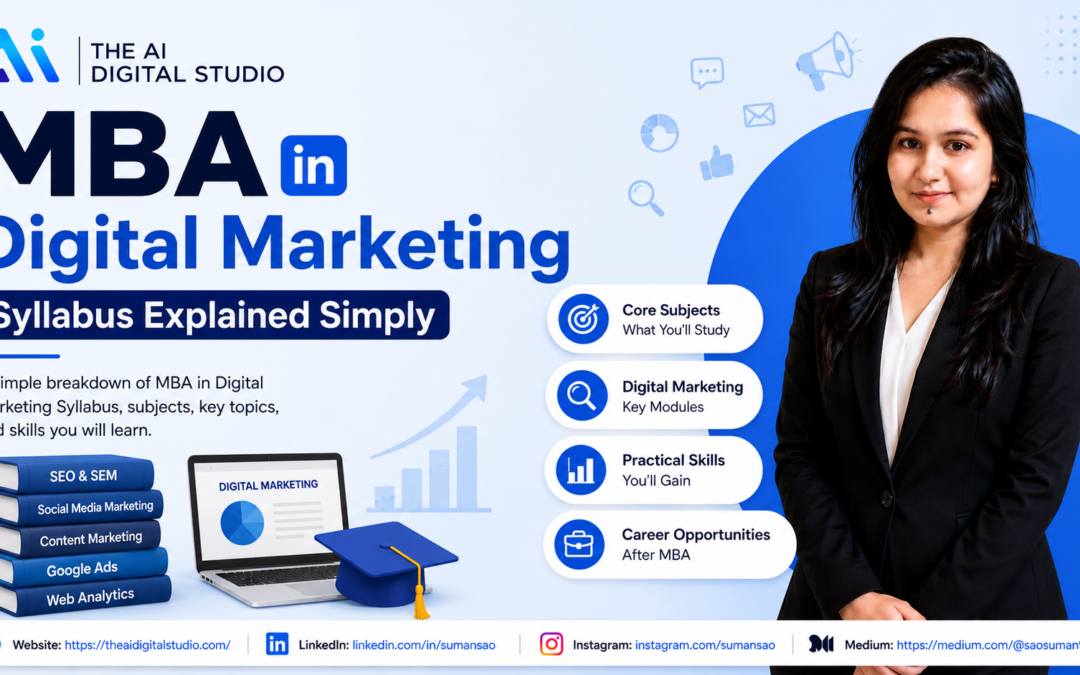
MBA in Digital Marketing syllabus explained simply. Learn subjects, modules, Digital Scholar trainers, founders, and career benefits in one detailed guide.
Contents
- 1 Introduction
- 2 What is an MBA in Digital Marketing?
- 3 Why the Syllabus Matters More Than the Course Title
- 4 MBA in Digital Marketing Syllabus Explained Simply
- 5 Foundation Subjects: Building Marketing Thinking
- 6 Branding and Consumer Behaviour
- 7 Search Engine Optimization (SEO)
- 8 Google Ads and Paid Advertising
- 9 Social Media Marketing
- 10 Content Marketing and Copywriting
- 11 Website Building and Landing Pages
- 12 Analytics and Reporting
- 13 Email Marketing and Automation
- 14 AI Tools in Modern Marketing
- 15 Management and Communication Skills
- 16 Career Readiness Modules
- 17 Why Digital Scholar’s MBA in Digital Marketing Stands Out
- 18 Role of Trainers in Student Success
- 19 Career Opportunities After Completing the Course
- 20 Conclusion
- 21 FAQs
Introduction
Choosing the right postgraduate course is no longer only about getting a degree. Students today want education that can lead to real jobs, practical skills, strong career growth, and future relevance.
This is one of the biggest reasons why interest in an MBA in Digital Marketing has grown rapidly in recent years. As businesses continue shifting online, companies need professionals who understand how to attract customers, build brands, generate leads, and increase revenue through digital platforms.
However, before joining any program, one question naturally comes to mind: What is taught in the MBA in Digital Marketing syllabus? Many students know digital marketing has demand, but they are unsure whether the course focuses on theory, practical learning, tools, or career outcomes. Understanding the syllabus helps students decide whether the program matches their goals.
A strong syllabus should do more than explain marketing terms. It should train students in strategy, execution, analytics, communication, and modern platforms. It should also help them become employable in a competitive market.
This is why many learners consider Digital Scholar’s MBA in Digital Marketing course. With practical training, updated curriculum, experienced trainers, and industry-focused learning, the course is designed to help students become career-ready. In this blog, we will explain the syllabus in simple language and understand why each subject matters. Digital Scholar is one of the best digital marketing institutes in Chennai offering various digital marketing courses.
What is an MBA in Digital Marketing?
An MBA in Digital Marketing is a specialized management program that combines business fundamentals with online marketing skills. It is built for students who want to understand how brands grow in the modern digital world.
Unlike a traditional MBA that may focus mainly on finance, HR, operations, and general management, this course adds modern marketing areas such as SEO, social media, paid advertising, analytics, content strategy, automation, and customer acquisition.
This makes the program highly relevant for students who want careers in fast-growing industries where practical digital skills are in demand.
Why the Syllabus Matters More Than the Course Title
Many students select courses based on the title alone. But the real value lies in what is taught and how it is taught.
Two institutes may offer the same course name, but outcomes can be very different. One may teach outdated theory. Another may teach practical tools, live projects, AI systems, and interview readiness.
That is why the syllabus matters so much. It shows whether the course can help students build confidence, job skills, and real career value.
A strong MBA in Digital Marketing syllabus should combine three things:
- Marketing foundations
- Practical digital execution
- Career readiness
When these are balanced well, students gain both knowledge and employability.
MBA in Digital Marketing Syllabus Explained Simply
Let us understand the syllabus in a simple and structured way.
Foundation Subjects: Building Marketing Thinking
Every good marketer must first understand how businesses and customers behave. This is why the course begins with strong fundamentals.
Students learn how marketing works, why people buy products, how trust is built, and how brands position themselves in crowded markets. They also study customer journeys from first awareness to final purchase and repeat loyalty.
These subjects are important because tools may change over time, but customer psychology and brand strategy remain valuable for years.
Without this foundation, students may know how to use platforms but struggle to create meaningful campaigns.
Branding and Consumer Behaviour
Branding is much more than logos and colors. It is how people feel about a company. In this module, students learn how businesses create identity, trust, consistency, and emotional connection.
Consumer behaviour helps students understand why customers click, compare, delay decisions, or make purchases. This gives marketers a major advantage because successful campaigns depend on understanding people, not just platforms.
Students who master these areas become stronger strategists rather than only tool users.
Search Engine Optimization (SEO)
SEO is one of the most valuable skills in digital marketing because it helps websites rank on search engines like Google.
Students learn how keywords work, how content helps rankings, how technical website improvements matter, and how backlinks build authority.
SEO is powerful because it can generate long-term traffic without paying for every click. Many companies actively hire SEO professionals, making this module highly useful for career growth.
At Digital Scholar, practical exposure helps students understand SEO beyond textbook theory.
Google Ads and Paid Advertising
Many businesses need faster results than SEO can provide. That is where paid advertising becomes important.
Students learn how Google Ads works, how businesses appear on search results, how display ads reach audiences, and how remarketing brings visitors back.
This module usually covers budgeting, keyword targeting, ad copy, bidding strategies, and campaign optimization.
Paid advertising is a high-demand skill because businesses directly connect it with leads and revenue. Students who understand performance marketing often have strong job opportunities.
Social Media Marketing
Social media is now one of the strongest channels for brand building and customer engagement.
Students learn how platforms such as Instagram, Facebook, LinkedIn, and YouTube can be used for business growth. This includes content planning, audience engagement, growth strategy, campaign promotion, and paid social advertising.
A good syllabus does not treat social media as only posting images. It teaches how to create systems that support branding, leads, trust, and sales.
Digital Scholar’s practical teaching style makes this area especially useful because students work on content ideas and campaign thinking.
Content Marketing and Copywriting
Content remains central to digital success. Whether it is blogs, captions, landing pages, ad creatives, or email campaigns, businesses need communication that converts attention into action.
Students learn how to write useful content for search engines, persuasive copy for ads, structured content calendars, and messaging that reflects brand identity.
Copywriting is one of the most underrated skills in marketing. Even strong ads fail if messaging is weak. This module gives students an advantage across many career paths.
Website Building and Landing Pages
Traffic alone does not create business growth. Users need somewhere useful to go. That is why website understanding is important.
Students often learn website basics through platforms like WordPress. They understand pages, layout, navigation, content flow, and lead generation design.
Landing pages are another important area. These are focused pages created for campaigns with one clear goal such as collecting leads or driving purchases.
Marketers who understand websites perform better because they can improve conversion, not just traffic.
Analytics and Reporting
Modern marketing is measurable. Businesses want to know what works and what wastes money.
Students learn tools like Google Analytics and reporting systems that track traffic, conversions, audience behaviour, campaign results, and return on investment.
This module is important because companies value marketers who can interpret numbers and make better decisions. Data literacy often separates average marketers from growth-focused professionals.
Email Marketing and Automation
Many people underestimate email marketing, but it remains one of the highest ROI channels in business.
Students learn how to build subscriber lists, create email campaigns, design welcome flows, nurture leads, and improve retention.
Automation tools also help businesses save time while maintaining customer communication. These skills are especially useful in e-commerce, education, consulting, and service businesses.
AI Tools in Modern Marketing
A modern MBA in Digital Marketing syllabus should include AI. Today’s marketers use AI for research, content support, workflow efficiency, reporting assistance, and idea generation.
AI does not replace strategy, but it improves productivity. Students who understand how to use AI responsibly become more efficient and valuable in the market.
Digital Scholar includes AI-focused learning so students stay aligned with future industry needs.
Management and Communication Skills
Because this is an MBA-level course, management skills are also part of learning.
Students improve presentation skills, teamwork, communication, leadership thinking, and strategic planning. These abilities become highly valuable when moving into senior roles or client-facing positions.
Digital marketing careers often grow quickly. Strong communication can accelerate promotions and opportunities.
Career Readiness Modules
A great syllabus should not stop at teaching subjects. It should also prepare students for opportunities.
This includes resume building, interview preparation, LinkedIn optimization, portfolio development, and personal branding.
Students who complete a course with both skills and proof of work often perform better in placements.
Why Digital Scholar’s MBA in Digital Marketing Stands Out
Many students choose Digital Scholar because the institute focuses on execution, not only theory.
The founders built the brand to solve a common problem in education students had certificates but lacked practical ability. Their vision was to create job-ready marketers who understand how businesses grow online.
This vision is reflected in the course structure today.
Students benefit from experienced trainers, updated modules, hands-on assignments, industry-focused learning, and career support. Instead of passive classroom teaching, the course encourages action and application.
Role of Trainers in Student Success
Even the best syllabus depends on the people teaching it.
Digital Scholar’s trainers are known for practical industry experience. They help students understand current trends, platform changes, common mistakes, and real campaign thinking.
Good trainers do more than explain lessons. They build confidence, solve doubts, and help students think like professionals.
This is one reason students value mentor-led learning.
Career Opportunities After Completing the Course
An MBA in Digital Marketing opens multiple career paths.
Students can move into roles such as Digital Marketing Executive, SEO Analyst, Performance Marketer, Social Media Manager, Content Strategist, Paid Ads Specialist, Growth Executive, Freelancer, or Consultant.
The flexibility of the field is one of its biggest strengths.
Conclusion
Understanding the MBA in Digital Marketing syllabus is important before choosing any course. A valuable syllabus should combine business fundamentals, digital execution, analytics, communication, AI tools, and career readiness.
When taught properly, these subjects help students become employable and future-ready.
Digital Scholar’s MBA in Digital Marketing course stands out because of its founder-led vision, practical teaching model, experienced trainers, updated curriculum, and focus on real outcomes.
If you want more than a certificate and prefer skills that businesses genuinely value, this course can be a smart step forward.
FAQs
1. What subjects are included in MBA in Digital Marketing syllabus?
SEO, Google Ads, social media, branding, analytics, websites, content marketing, automation, and AI tools are commonly included.
2. Is MBA in Digital Marketing syllabus practical?
Yes, good institutes include assignments, projects, live tools, and campaign-based learning.
3. Why choose Digital Scholar for MBA in Digital Marketing?
Digital Scholar offers practical training, experienced trainers, updated syllabus, and placement support.
4. Does MBA in Digital Marketing include AI?
Many modern programs now include AI tools and automation learning.
5. What jobs can I get after MBA in Digital Marketing?
You can work in SEO, paid ads, content, social media, growth marketing, or consulting roles.